Here are some videos by and about New Era Colorado, who'll be visiting us in class on October 23rd to ask your help with their "trick or vote" campaign. The group's goal is to make politics inviting and exciting to folks in their late teens and twenties, and the "trick or vote" campaign looks like it'll be a lot of fun.
Here's an overview of the group's work:
Here are some videos about the "trick or vote" campaign:
And here's a spoof of MTV Cribs that they did during the mayoral race:
Monday, October 1, 2012
Wednesday, September 26, 2012
Imperialism, Part 1
Your Homework for this week....
1. Read the two short book sections posted on Blackboard (one from Mandela’s autobiography; one from Gandhi’s autobiography)2. You have 2 choices for the second part of your homework: Attend the Invisible Children film screening and talk-back on Monday, Oct. 1 (7 pm, Lindsay Auditorium), OR read the following articles and watch the following interview:
http://www.theatlantic.com/international/archive/2012/03/the-soft-bigotry-of-kony-2012/254194/
http://sayhelloafrica.com/post/18893492141/kony-2012-why-i-love-the-idea-but-hate-the-campaign **read through some of the comments on this one, too!
**There is an ongoing debate, especially within development/humanitarian circles, about whether certain Western approaches to issues in developing countries are inherently imperialist. Invisible Children has been put at the center of this debate in a pretty public way this year with the KONY2012 campaign. Please note that I’m not saying that Invisible Children is an imperialist organization, but rather asking you to look directly at this issue (and the debate surrounding it) with a critical eye.

Sunday, September 23, 2012
Staging Race and Bearing Witness
Segregated buses in Alabama, ca. 1940-1956:


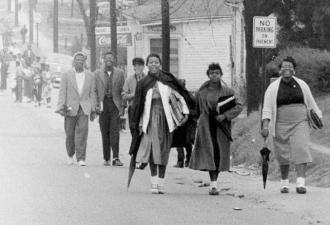
 Scenes from the 1956 Montgomery Bus Boycott:


From Ronald Reagan's speech to the American Business Conference (1985):
From the Clint Eastwood film Sudden Impact (1983), the fourth film in the Dirty Harry series:
From Dirty Harry (1971):
A 9.21.2012 story on News People Need, titled "Recent Empty Chair 'Hangings' Suggest Anti-Obama Protest Gone to Extreme."




Rosa Parks rides a Montgomery bus integrated as a result of the boycott (1956):
Scene from Southland (1951/2012):

Clint Eastwood speech at the GOP National Convention (2012):
From Ronald Reagan's speech to the American Business Conference (1985):
From the Clint Eastwood film Sudden Impact (1983), the fourth film in the Dirty Harry series:
From Dirty Harry (1971):
A 9.21.2012 story on News People Need, titled "Recent Empty Chair 'Hangings' Suggest Anti-Obama Protest Gone to Extreme."
Thursday, September 20, 2012
The Montgomery Bus Boycott

For Tuesday, please read the chapter titled “The Montgomery
Bus Boycott,” from Taylor Branch’s Parting
the Waters: America During the King Years, 1954–63; and then, by the start
of Tuesday’s class, please post to our discussion board a 250–300-word response
to the following:
You are likely familiar with the Montgomery Bus Boycott, the protest action against racial segregation that began when African American Civil Rights activist Rosa Parks refused to give up her bus seat to a white passenger. The Boycott was not only a successful protest campaign in its own right; it quickly became a potent and enduring symbol of the quest for social justice nationally and globally, inaugurating the Civil Rights Movement in America and inspiring similar mass movements around the world. What, in your opinion, is the secret of the Boycott’s social and symbolic power? That is, why, do you believe, did the Boycott succeed in striking such a powerful blow against the injustice of segregation? And why has it also succeeded so well in embodying the idea of social justice more broadly?
The Branch chapter is on Blackboard, in the Content folder.
Please note that it’s in two parts (i.e., two PDF files). The chapter focuses on the Boycott itself, not on the episode involving Rosa Parks that sparked it. If you'd like to learn more about Rosa Parks's act of protest, you can read this story from the LA Times.
Monday, September 10, 2012
Welcome to SJUS 2010!
Southland assignment
 |
| Julie Belafonte, in an early 1950s production of Southland. |
With this in mind, how do you interpret the historical significance of the production of Katherine Dunham's Southland, performed by the Cleo Parker Robinson Dance Ensemble? What neglected, distorted, or erased histories does it bring back into view? How does this production speak to our present moment? What alternative visions of the future does it challenge us to imagine?
By the start of class on Tuesday the 18th, please post a 250-300-word response to any or all of the questions above on our class discussion board. And please feel free -- indeed, encouraged! -- to engage with your classmates' posts.
By the start of class on Tuesday the 18th, please post a 250-300-word response to any or all of the questions above on our class discussion board. And please feel free -- indeed, encouraged! -- to engage with your classmates' posts.
(By the way, you might want to check out the article about Southland that appeared in the Denver Post the other day.)
Subscribe to:
Posts (Atom)